Top 5 AI Tools Every Small Business Should Consider for Growth
Top 5 AI Tools Every Small Business Should Consider for Growth
Mark, the owner of a boutique digital marketing agency, used to spend his evenings manually compiling performance reports for clients. He was good at strategy, but the data crunching was draining his time and creativity. Then, he implemented an AI analytics tool. Suddenly, those reports generated themselves overnight, complete with predictive insights. Mark didn't just save time; he started selling insights instead of creating them. His story highlights a critical shift: AI is no longer just for tech giants; it’s the essential equalizer for small to medium businesses (SMBs).
The data supports this transformation: 91% of AI-using SMBs report revenue increases after adoption . However, simply buying software isn't enough. To truly grow, you need to know which tools to use and how to use them effectively.
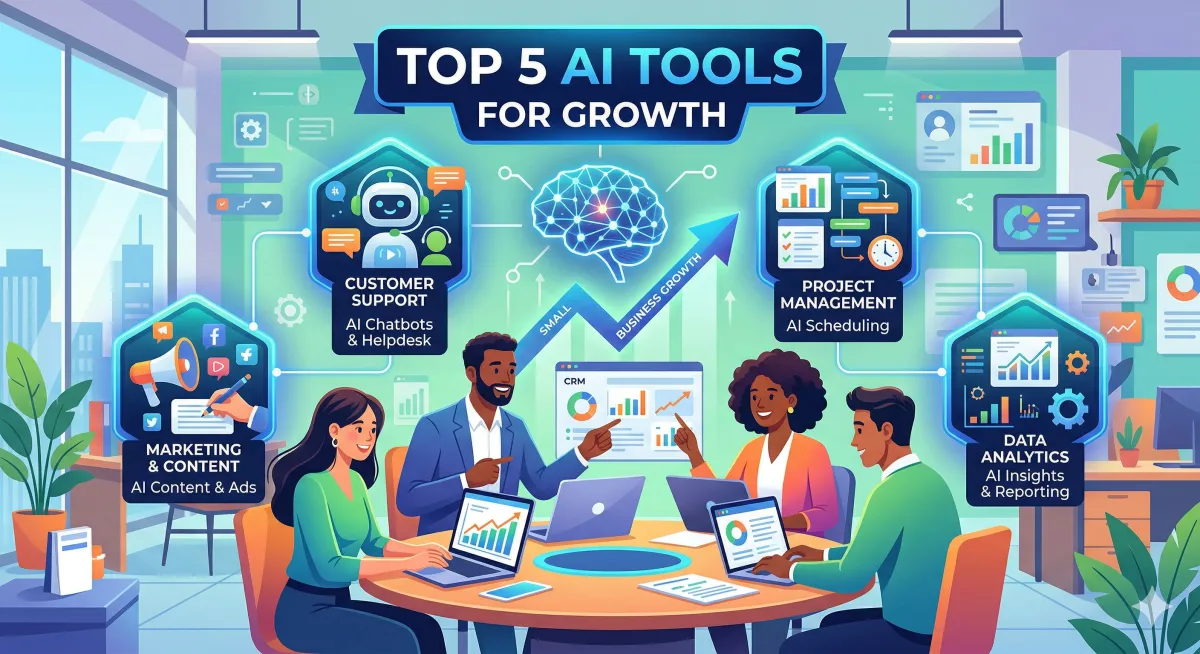
Here are the top five categories of AI tools that can drive measurable growth for your SMB, backed by industry results:
1. AI-Powered CRM & Sales Automation
For sales teams, AI moves beyond simple contact management to intelligent pipeline nurturing. These tools focus on ensuring you get more customers and increase customer satisfaction by never letting a hot lead go cold.
What it does: Uses predictive lead scoring to tell you which prospects are most likely to close, automates personalized follow-up emails, and summarizes customer interaction history.
The Impact: Businesses using AI in sales see significant gains. Some tools have demonstrated a 25% increase in sales-ready leads and up to a 25% reduction in customer acquisition costs by automating outreach and lead sourcing .
Example Focus: Tools that integrate AI directly into your CRM to prioritize your sales team’s daily activities.
2. Intelligent Workflow & Operations Automation
This category directly addresses the pain point of automating manual, repetitive tasks and lowering labor cost. These tools connect your existing software stack (like your accounting, project management, and communication apps) and use AI to make decisions between them.
What it does: Creates automated "if-this-then-that" sequences that handle data entry, invoice processing, scheduling, and internal reporting without human intervention.
The Impact: Studies show that small businesses using AI for operational efficiency can save an average of $7,500 annually , with the top quarter saving over $20,000 yearly. One firm saved ten hours per employee per week by automating data entry alone .
Example Focus: Platforms that act as a central nervous system, routing information correctly and flagging anomalies.
3. Generative AI for Marketing & Content Creation
In the competitive digital space, content volume and personalization are key to getting more customers. Generative AI acts as an always-on creative partner.
What it does: Drafts blog posts, creates social media copy, generates ad variations, and even designs initial marketing assets based on simple text prompts.
The Impact: 60% of small businesses using AI in marketing report saving time and money while enhancing results . This allows smaller teams to compete with larger organizations on content volume and consistency.
Example Focus: Tools that ensure your content remains on-brand and optimized for search engines.
4. AI-Driven Customer Service & Experience
Improving customer satisfaction and lessening missed opportunities after hours is a major win for SMBs that can’t afford 24/7 staffing.
What it does: AI chatbots and support assistants handle high-volume, simple customer queries instantly, 24/7. Advanced tools can also analyze customer sentiment in real-time to prioritize urgent issues for human agents.
The Impact: Companies using AI for customer service often report improved response quality and speed. Furthermore, integrating AI into support can also bolster cybersecurity by flagging suspicious requests or unusual account access attempts.
Example Focus: Chatbots that can seamlessly hand off complex issues to a human agent without losing context.
5. AI for Financial Forecasting & Data Analysis
Gut feeling is replaced with data-backed certainty when AI analyzes your financial streams.
What it does: Forecasts cash flow with greater accuracy, spots unusual spending patterns that could indicate waste or fraud, and analyzes sales data to guide purchasing and investment decisions.
The Impact: Better financial forecasting leads directly to better resource allocation. Businesses that connect AI activity to real money metrics often see a 29% increase in online sales in a single quarter from AI-enabled customer journeys .
Example Focus: Tools that turn raw transaction data into actionable, forward-looking business intelligence.
Making the Leap with Expert Guidance
Adopting the right tools is only half the battle; ensuring they integrate smoothly and deliver that promised ROI is the other. This is where specialized advisory services become invaluable. They help you select the right tools from the start, avoiding the costly mistake of buying software that doesn't fit your unique needs. For example, partners like Cyber Dogs AI specialize in helping small to medium enterprises implement AI solutions that directly address operational bottlenecks—from automating repetitive work to fortifying cybersecurity. They help ensure your investment translates into tangible results across all departments.
The AI landscape is moving fast, and the gap between those who strategically adopt and those who simply experiment is widening. By focusing on tools that target your specific growth levers—sales, operations, and customer experience—you maximize your return.
If you are ready to move from simply using AI to strategically profiting from it, what is the first area of your business you will task an AI tool to transform?
Related searches:
