
AI Employees vs. Human Employees: The Real Cost Comparison Every Business Owner Needs to See
Hiring is expensive, slow, and risky. AI employees are fast, scalable, and available around the clock. But are they right for your business — and where does human talent still win? Here's the honest breakdown owners actually need before making the call.
The real cost of a human hire nobody talks about
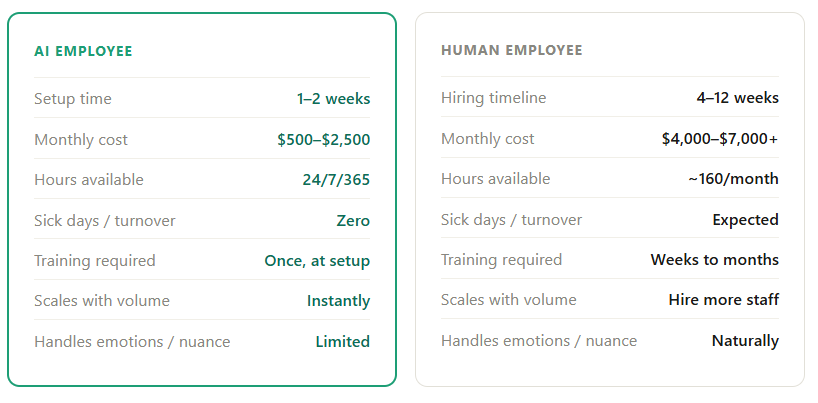
Most business owners think about salary when they think about hiring. But that's only part of the picture. By the time you add recruiting, onboarding, benefits, payroll taxes, training time, turnover risk, and management overhead, a $45,000-a-year employee can cost your business anywhere from $60,000 to $75,000 annually — before they've fully ramped up.
That doesn't make humans bad hires. It makes the decision more nuanced than most owners realize. The question isn't "human or AI?" — it's "which tasks belong to which?"
Side by side: what the numbers actually look like
Where AI employees win — without question
There are entire categories of work where AI consistently outperforms human hires: high-volume, repetitive, time-sensitive tasks where speed and consistency matter more than intuition. Think about how much of your business fits this description:
Answering the same 20 customer questions every day. Following up with leads who didn't convert. Booking, rescheduling, and confirming appointments. Triaging inbound calls after hours. Sending invoices, reminders, and review requests. Processing routine data entry. These are not creative challenges — they're operational drain. And they're exactly where AI pays for itself fastest.
"Every hour your team spends on work an AI could handle is an hour they're not spending on work only a human can do. That's your real hidden cost."
Where humans still have the edge
AI is a tool, not a replacement for everything human. Complex sales conversations, high-stakes client relationships, creative problem-solving, team leadership, and situations that require genuine empathy — these still belong to people. The businesses getting the best results from AI aren't replacing their teams. They're freeing their teams to do more of the high-value work that actually grows revenue.
The smart play is a hybrid model: AI handles the predictable, high-volume work. Your people handle the relationships, judgment calls, and strategy.
The myths holding business owners back
❌ AI takes months to set up and integrate.
✅ A well-built AI voice agent or chatbot can be live in one to two weeks, trained on your specific business data.
❌Customers hate talking to AI.
✅ Customers hate waiting, being put on hold, and getting wrong answers. A well-trained AI avoids all three — often better than an undertrained human hire.
❌ AI only works for big companies.
✅ Small and mid-size businesses see the fastest ROI because their margins are tighter and their time is scarcer. The impact is proportionally larger.
❌ You need a tech team to manage it.
✅ Done-for-you AI solutions handle the technical side completely. You give direction, the AI partner builds and manages the rest.
How to decide what to automate first
The most common mistake is trying to automate everything at once, or worse, automating something that isn't actually causing pain. Before you bring on any AI employee, ask yourself three questions:
Where is my team spending the most repetitive time? Count the hours. If a task happens more than 10 times a week and follows a predictable pattern, it's a candidate.
Where am I losing customers due to slow response? Missed calls, delayed follow-ups, and after-hours gaps are measurable revenue losses. AI closes them instantly.
Where does human error cost me money? Data entry, scheduling conflicts, missed reminders — AI doesn't forget, fatigue, or make the same mistake twice.
The bottom line for business owners
You don't have to choose between people and AI. The most profitable businesses in 2026 are choosing both — strategically. They're using AI to handle the volume, free up their team, and operate with the efficiency of a company twice their size. And they're doing it without doubling their payroll.
The question isn't whether AI will change how your business operates. It already is — for your competitors. The question is whether you'll get ahead of it or catch up later.
